


Good morning everyone. Hope you’re all ok and have had a good week. It’s been a struggle for me health wise unfortunately, but I didn’t let it disrupt our little mini-vacation that we had whilst my dad was off. We took a little break away and went to West Midlands Safari Park which was amazing, some of the animals including Giraffes, Zebras and Rhinos to name a few came right up to our car which I took full advantage of to take numerous pictures (plus my mum got to see her favourite animal – a white tiger and I got to see mine – penguins), so we left rather happy, we ended up being away for a couple of days which was really nice and very much needed, but in that whole time I ended up becoming really ill with my ribs, which led with me having to go to the Doctor’s as my rib cage kept causing me a lot of problems especially discomfort, well it turns out that was because I have an infection in them which can apparently take several months to heal, but other than pain medication and heat packs there’s not really any other treatment they can provide, so for now I just have to try and manage the best I can unless it gets too severe than I may have to go to the hospital.
But anyway, on with this week’s post, which I honestly didn’t plan but works for today’s topic…Chronic Disease Day. Some of the most common chronic diseases that can have a debilitating impact on a person’s life include heart disease, type 2 diabetes, arthritis, osteoporosis, colorectal and many others. These diseases may come out of nowhere, but many times there are various warning signs that allow them to be caught early and treated more proactively. July 10th is Chronic Disease Awareness Day and is here to increase public knowledge and work hard to improve access to health information of each person in every community!
Chronic Disease
What is a Chronic Disease?
Chronic diseases are non-communicable diseases, that is, they are not passed from person to person. They are generally of long duration and slow progression. It is an illness that does not currently have a cure. Instead, treatment aims to manage the symptoms and help the person live the best life possible with their condition. The most common types of chronic disease are cancer, heart disease, stroke, diabetes, and arthritis, but there are so many more that have a long lasting affect. People living with chronic illnesses often must manage daily symptoms that affect their quality of life, and experience acute health problems and complications that can shorten their life expectancy. According to the Centers for Disease Control, chronic disease is the leading cause of death and disability in the United States, accounting for 70% of all deaths. Moreover, chronic conditions such as back pain and depression are often the main drivers of decreased productivity and increased healthcare costs. Data from the World Health Organization show that chronic disease is the major cause of premature death around the world, even in places where infectious disease are rampant. The good news is that through effective behavior change efforts, appropriate medical management, and systematic monitoring to identifying new problems, chronic diseases and their consequences can often be prevented or managed effectively.

Types of Chronic Diseases
- ALS (Lou Gehrig’s Disease)
- Alzheimer’s Disease and other Dementias
- Arthritis
- Asthma
- Cancer
- Chronic Fatigue
- Chronic Obstructive Pulmonary Disease (COPD)
- Crohn’s Disease, Ulcerative Colitis, Other Inflammatory Bowel Diseases, Irritable Bowel Syndrome
- Cystic Fibrosis
- Diabetes
- Eating Disorders
- Heart Disease
- Obesity
- Oral Health
- Osteoporosis
- Reflex Sympathetic Dystrophy (RSD) Syndrome
- Sudden Cardiac Arrest (SCA) in Youth
- Tobacco Use and Related Conditions

What is the prognosis?
All long-term conditions are chronic, meaning they cannot be cured. However, they may differ in how they develop over time:
A progressive condition is the term given to conditions which gradually worsen over time. Dementia and chronic obstructive pulmonary disease are progressive conditions and can ultimately result in a reduced lifespan. Specific conditions might progress in a “stepped” fashion. For example, the symptoms of vascular dementia are relatively stable but will worsen each time the patient experiences a stroke or mini-stroke.
A fluctuating condition involves symptoms that vary over time, sometimes with a degree of unpredictability. Chronic depression is often included in this category, as well as chronic fatigue. In conditions such as irritable bowel syndrome, periods of suddenly worsening symptoms are known as “flare ups”.

Who is affected?
Many long-term conditions can affect people at any age, but they are much more commonly seen in older people . 58% of people over the age of 60 have a long-term condition, compared with just 14% of people under the age of 40.
A large number of people in the UK are living with more than one long-term condition, a situation known as “multi-morbidity”. For example, the majority of people over the age of 75 live with two or more long-term conditions .
Many long-term conditions are associated with lifestyle factors such as poor diet, being overweight, or smoking. Others are directly associated with the ageing process, such as cognitive decline in the case of dementia. Because of this, many chronic conditions take a long time to develop to the point of diagnosable symptoms, and this can help explain their increasing incidence later in life.
Common Stresses Of Having a Chronic Disease
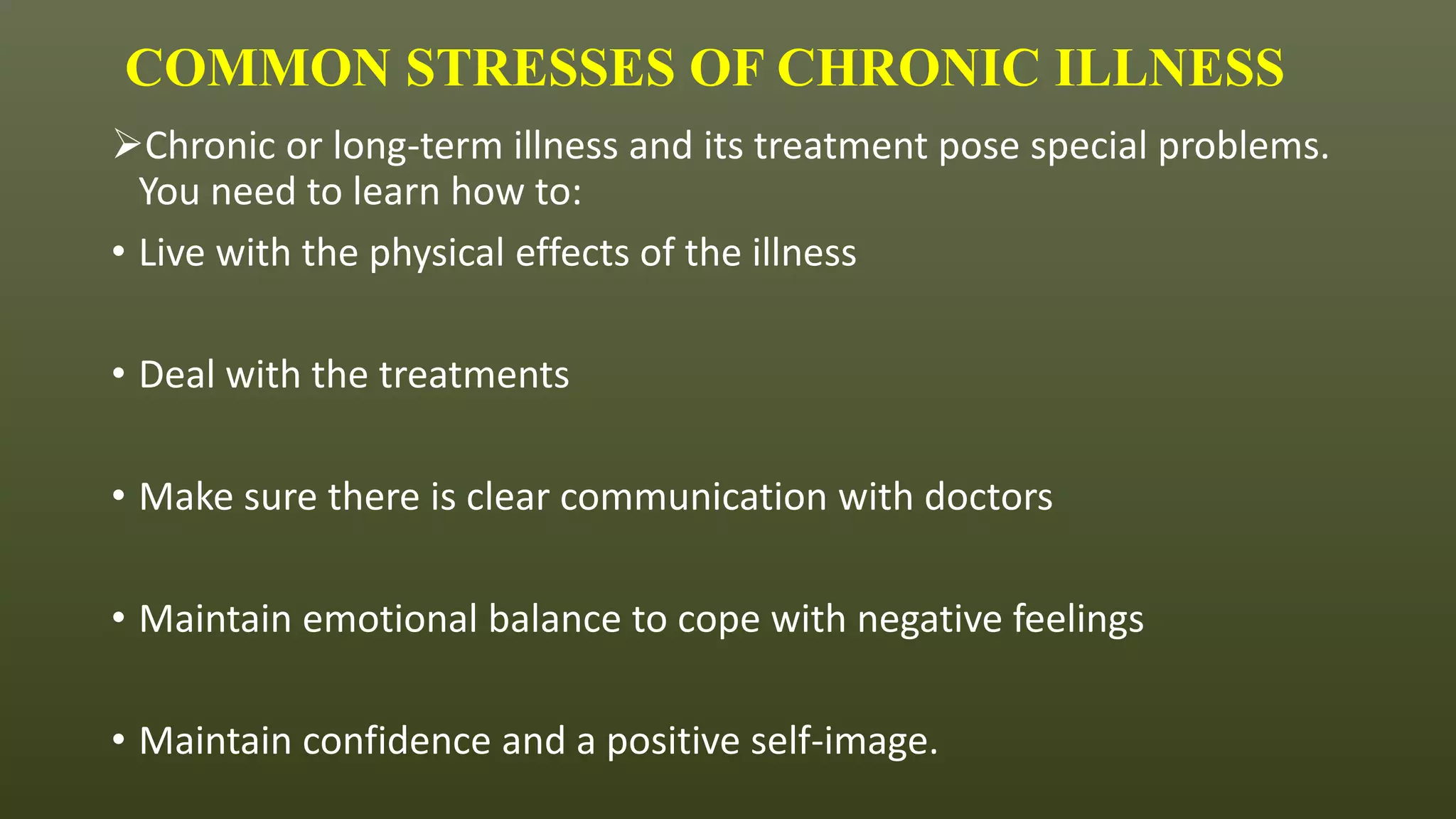
The most important thing you can do is to seek help as soon as you feel less able to cope. Taking action early will help you understand and deal with the many effects of a chronic illness. Learning to manage stress will help you to maintain a positive physical, emotional and spiritual outlook on life.
If you ask for help from a mental health provider, the two of you can design a treatment plan to meet your specific needs. These strategies can help you regain a sense of control and improve your quality of life—something everyone deserves. If you’re suffering from depression, your provider may prescribe medications to help regulate your mood and make you feel better.
There are, of course, things that you can do on your own that will help. These include tips such as:

- Eating a healthy diet.
- Getting as much physical activity as you can.
- Avoiding negative coping mechanisms like alcohol and substance abuse.
- Exploring stress-relief activities like meditation.
- Letting of obligations that you don’t really need to do or want to do.
- Asking for help when you need it.
- Staying in touch with family and friends.
What kind of help is available for someone with a chronic illness?

You can find help for stress related to chronic illness. Counseling options include support groups, individual counseling and/or family and couples counseling.
Support groups
Support groups are a useful sharing experience. They provide an environment where you can learn new ways of dealing with your illness from other people’s coping strategies. You may want to share your own approaches, too. You’ll know that you aren’t facing hardships alone. You can often find these groups by contacting a nonprofit organization that is dedicated to your specific disease.
Individual counseling
Sometimes people have problems that are better addressed in a one-on-one setting. By taking part in individual counseling, you may more effectively express sensitive or private feelings you have about your illness and its impact on your lifestyle and relationships. There is a specific group of trained of mental health providers who have extensive training in coping with chronic illnesses.
Family and couples counseling
A chronic illness often affects the family unit. It’s important to find a family or couples-trained mental health provider in these cases.

How to Observe Chronic Disease Awareness Day
Show some support for friends, family members or others with chronic disease and get involved by learning about prevention and early detection with some of these activities for Chronic Disease Awareness Day:
Schedule a Wellness Checkup
One of the most important factors in prevention of chronic disease is preventative health care. Don’t forget to schedule an annual wellness checkup with a general practitioner and let them know about any concerns or issues. This type of doctor visit may include a blood pressure check, weight check, blood sugar levels, cholesterol screening, vitamin deficiency and more. The doctor may also request other routine tests such as a colonoscopy, mammogram or pap smear for people of a certain age or gender.
Participate in the “I Stay Strong” Campaign
One of the ways that Chronic Disease Awareness Day seeks to improve the public understanding of chronic disease is by hosting a social media campaign. Individuals who have a chronic disease can participate in the campaign by determining what is their most important reason to stay strong.
For instance, I stay strong for: “my family”, “my future”, “my body” or some other reason. That short phrase can be written on the palm of the hand and then snap a photo that includes both your face and hand. Post the photo on social media outlets like Instagram or Facebook, use the hashtag and tag three or more friends for the possibility of getting a mention from the Chronic Disease Day website.
Chronic illness affects many people in the U.S. and worldwide. Each has its own symptoms. If you have a chronic disease, you may find yourself facing increased levels of stress. There are ways to manage the stresses of everyday life. Make sure you talk to your healthcare provider for tips about stress management. Write down your questions and get answers to them.
Thank you for coming to my blog and reading today’s post, I hope you all have a lovely week and enjoy the sun when its here, fingers crossed it will come out again soon! For now though I shall say enjoy the rest of your day and I will see you next week.


 Peytons View
Great post. How do you get an infection in your ribs? I haven’t heard of that before. I sure know the pain and it can take you to your knees. I’m glad you got to semi enjoy your break, it’s great your parents went with you, what great memories. You’ll cherish them forever. Take good care.
LikeLiked by 2 people
I’d never heard of it before either and neither had my parents but apparently you can, I even looked it up on Google and read about it, the medical term they use is Costochondritis which I’ve also linked > https://www.mayoclinic.org/diseases-conditions/costochondritis/symptoms-causes/syc-20371175 < if you want to know more information! I’m sorry to hear that, i hope it doesn’t affect you too much. Thank you, we did, I’m very close with my parents and you’re absolutely right, we will forever cherish these memories that we make 😀 I hope you look after yourself too.
LikeLiked by 1 person
I’ve had Costorhondritis but I didn’t realize the pain was from my ribs. I must have had a light case because I wasn’t in that kind of pain. Take good care.
LikeLiked by 1 person
I’m glad you got better from it and that you didn’t have a severe case, I would not wish this on anybody. Take care and look after yourself too.
LikeLiked by 1 person
The weird thing I did get after healing from that is pain in my Clavicle which I ended up seeing a Nuerologist from. If by any chance that happens or you don’t heal soon, have a Lyme test done. Your regular doctor doesn’t do enough test to know for sure you have Lyme. If this perseist find A Lyme Literate Doctors. If you do need to find one let me know and I can find the website that Lyme doctors join and you can get refferals from them. Lyme is a tricky illness and everyone can have different symptoms. Lyme almost killed me and I never tested positive for it. The true test to know if you have any Tick Borne Dieases is a test by Genex and they are expensive but very worth it. Insurance doesn’t cover the cost of Lyme treatments in America and it cost over $150,000 out of pocket. It’s no different today, the CDC doesn’t accept long tern Lyme so insurance doesn’t pay. I pray that’s not the case but if your outside a lot it’s something to think about. I did a post today that talks about how Lyme lives in your immune system. Thank goodness I’m in remission, you aren’t cured but not overwhelmed by the effects of.
LikeLiked by 1 person
I’m sorry it got that bad and that it caused you to have to go through that, I’m glad to hear your better now! I don’t personally think I have it, but I will keep an eye out for the signs and if need be, try and get tested. Thank you for the offer, I will keep it in mind if anything does happen.
LikeLiked by 1 person
I hope it doesn’t and you heal fast.
LikeLiked by 1 person
Great informative post. Thanks for sharing. Sorry to hear about your ribs infection. Glad you’re feeling better … take care of yourself.
Also great to hear that you spent some quality time with your parents – those are irreplaceable memories indeed.
LikeLiked by 2 people
Thank you for your kind words, unfortunately not feeling better yet, it may take some time, but Im a tough cookie! I 100% completely agree that they are irreplaceable memories that you should always cherish. Take care of yourself too.
LikeLiked by 1 person
Will do and hope that your today will always be better than your yesterday.
LikeLiked by 1 person