
Good Morning my wonderful friends/followers, how are you all doing? There’s been a few good and bad moments that have happened this past week, let’s start with the bad things that have occurred – 1. I received the results from the second blood test I had which confirmed the first test was right, there is something wrong with my kidneys, so I’m having to undergo further testing and have an ultrasound which I’m currently waiting for one to be scheduled, hopefully, then I can find out what’s wrong, otherwise I don’t know what’s going to happen next. 2. My aunties dog is really sick at the moment, sadly she’s been told that she’s only got a couple of weeks left (maximum), so she’s absolutely devastated right now (she’s 15 years old (around 76 in dog years) but she’s lived a fantastic life). 3. My dad has had to take his car into the garage to get it fixed as it lost all its power to the point where it barely moved while we were trying to leave our driveway. And 4. My mum has had to have some blood tests done to find out why she’s constantly tired all the time as she has absolutely no energy, so we’re hoping the doctors can give her some answers and that it can be easily treated (fingers crossed). But there has been some good news to come out of this week, my mum started physio on her back to try and get it straightened which hopefully with the physiotherapist she’ll be seeing could see an improvement by Christmas! I know she’s willing and ready to do the exercises they provide her with to get her back to what it once was.
Now I’ve finished waffling on, let’s move on to this week’s post…October is Breast Cancer Awareness Month. The entire month is a reminder that there is a gruesome disease that affects 1 in 8 women and 1 in 1000 men. Breast cancer is a terrible disease that will develop into invasive breast cancer throughout a lifetime for millions of men and women. Being proactive in this fight is crucial. During October, there are reminders everywhere saying “Hey, don’t forget to examine your breasts, get your doctor to check them out too, and schedule your mammogram.” A mammogram only takes a few seconds of pressure on each breast during examination. Though they can cause a bit of discomfort, the exam is worth it. Getting regular mammograms can help detect cancer in its earliest stages when it is most easily treated. This post is very dear to my heart as several members of my family throughout the years have sadly been diagnosed with breast cancer and I wanted to raise awareness in honor of those that we’ve lost because of this awful disease and to make sure everyone is checking their breasts.
What Is Breast Cancer?
Breast cancer is when abnormal cells in the breast begin to grow and divide in an uncontrolled way and eventually form a growth (tumor). Breast cancer most commonly starts in the cells that line the milk ducts of the breast. It is the most common cancer in the UK. It mainly affects women, but men can get it too.
The Breasts
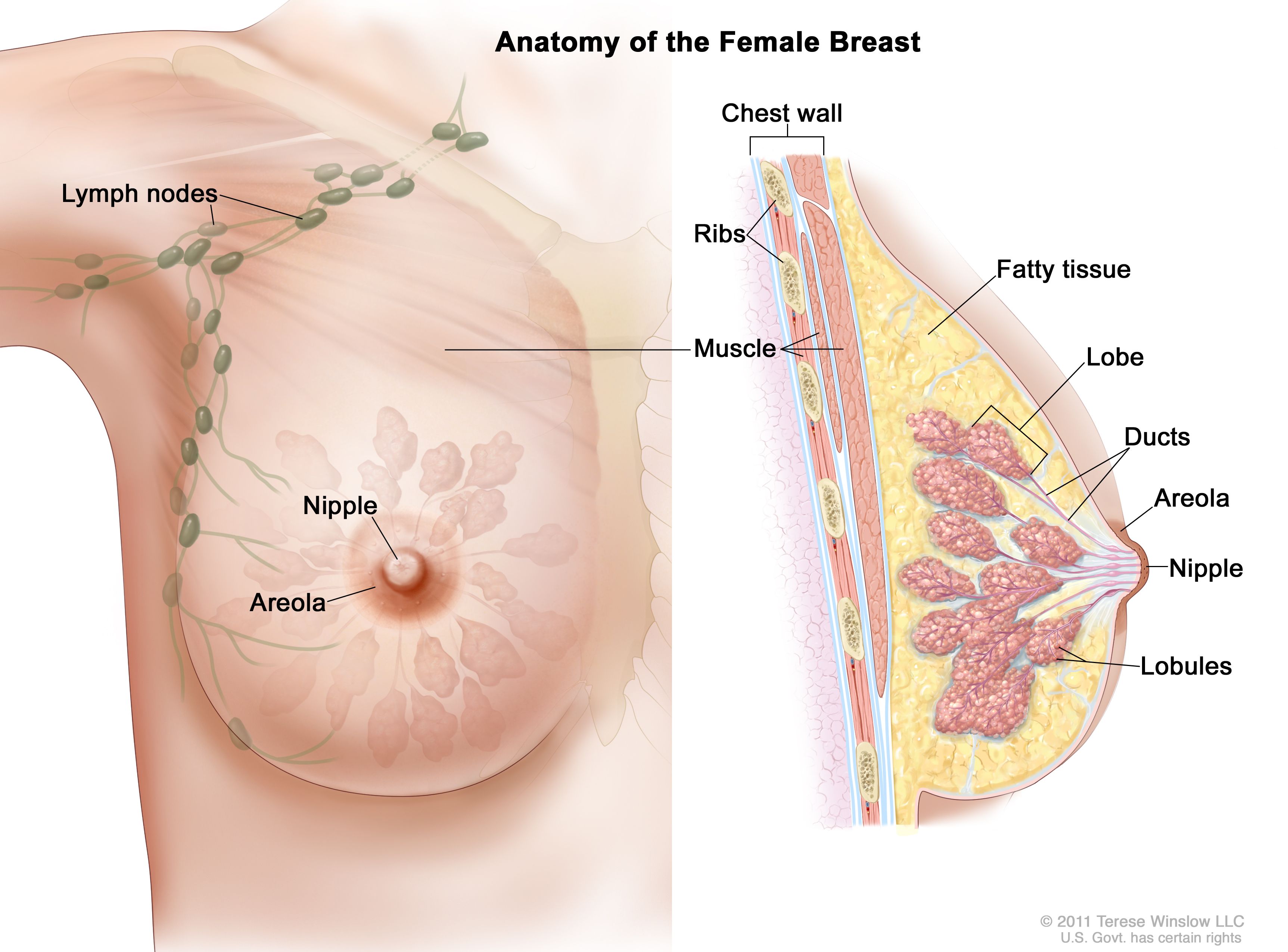
Breasts are made up of:
- Fat
- Glandular tissue is divided into lobes (each containing lots of lobules)
- A network of ducts or milk ducts
- Connective tissue
The lobules produce milk for breastfeeding and connect to the ducts. The ducts spread from the lobes towards the nipple.
Breast Size And Density
One breast is usually smaller than the other. Your breasts may feel different at different times of the month. It is common for breasts to feel lumpy just before your period. Younger women have more glandular tissue than fat in their breasts, making them dense. Your breasts also change during pregnancy. You may notice that they become bigger and feel more tender. After your periods stop (menopause) fat gradually replaces the glandular tissue, which is less dense.
Lymph Nodes
There is a network of lymph glands close to the breast. These are also called lymph nodes. They are part of the lymphatic system that runs throughout the body. The lymph nodes and lymph vessels contain a yellow fluid called lymph that flows through the lymphatic system. It collects waste products and drains them into veins. Cancer cells that have broken away from the breast tissue can be carried by the lymph fluid to nearby lymph nodes. If you have cancer, but no cancer cells in any of your lymph glands, your cancer is less likely to have spread. The lymph glands in the armpit are called the axillary lymph glands. There are also lymph nodes in the center of the chest, close to the breastbone. These are called the internal mammary chain.

Symptoms of Breast Cancer
The first symptom of breast cancer most people notice is a lump in their breast or some thickening.
Breast symptoms to look out for:
- A new lump or thickening in your breast or armpit
- A change in the size, shape, or feel of your breast
- Skin changes in the breast such as puckering, dimpling, a rash or redness of the skin
- Fluid leaking from the nipple in a woman who isn’t pregnant or breastfeeding
- Changes in the position of the nipple
Breast Lump
Most breast lumps are not cancer. Lumps that aren’t cancerous are called benign lumps.
Most benign breast lumps are:
- Areas of normal lumpiness. These are usually more obvious just before a period
- Cysts. These are sacs of fluid in the breast tissue, which are quite common
- Fibroadenoma. This is a collection of fibrous glandular tissue which is more common in women younger than 40
It is important to always get a breast lump checked by your GP. They will arrange for you to have tests to find out whether your lump is cancer or not.
A Lump Or Swelling In Your Armpit
You can’t usually feel the lymph glands in your body. But they can become swollen when you have an infection or a cold. A less common cause of swollen lymph glands in the armpit is breast cancer which has spread to this area.
Change In The Size, Shape Or Feel Of Your Breast
Breast cancer might cause your breast to look bigger or have a different shape than usual, it might feel different. It can help to be breast-aware. This means getting to know the size, shape, and feel of your breasts.

Skin Changes
Skin changes of the breast include:
- Puckering
- Dimpling
- Rash
- redness
The skin might look like orange peel or the texture might feel different. Depending on your skin tone, some of these symptoms may look different or be harder to see. For example, what appears red on white skin may look darker or more of a reddish brown color on brown or black skin.
*Skin changes can also be caused by other breast conditions.*
Fluid Leaking From Your Nipple
Fluid leaking from the nipple when you’re not pregnant or breastfeeding. This can be a sign of breast cancer, but other medical conditions can also cause this.
Change In The Position Of Your Nipple
One nipple might turn in or sink into the breast. It might look or feel different than usual.
Breast Pain
Breast pain is common and it’s not normally due to cancer. You might get pain in one or both breasts. This usually goes away after some time. There might be no obvious reason for this pain, even if you have a lot of tests.
Breast Screening (Diagnosis)

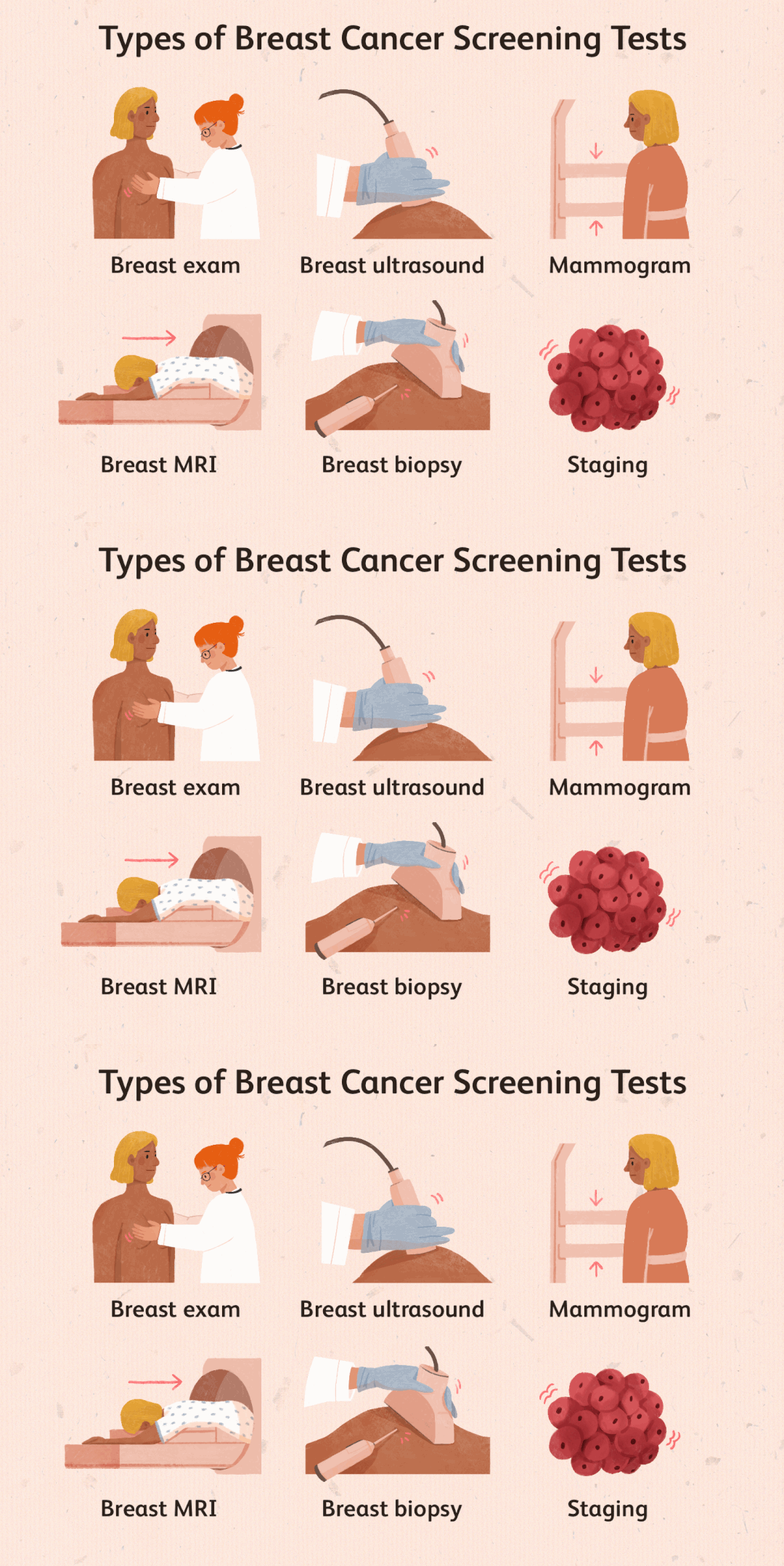
In the UK, women aged 50 – 70 are invited to have breast screening every 3 years as part of a national screening program. It is rare for men to have breast cancer, so they are not invited to be screened. Breast screening uses X-rays or sound waves to take pictures inside your breast and look for breast cancer. Breast cancer screening could be by one of 2 scans:
- Mammogram
- Ultrasound.
In most cases, the risks of screening women under 50 would outweigh the benefits. Women with a high risk of breast cancer can be screened at any age. However, low-risk women under 50 are not invited to be screened as part of the national screening program. X-ray exposes you to a tiny amount of radiation, and any radiation exposure can very slightly increase your risk of cancer. Mammograms of young women are also more difficult to read, as their breast tissue is denser. Women under 50 would need more frequent scans, so they would have more radiation exposure. It is important to get to know your breasts and chest area whether you are screened or not. Make sure you understand what is normal for you and your body. If you notice any unusual changes, make an appointment to see your GP, even if you have a scan appointment coming up.
Mammogram Screening
A mammogram is an x-ray of the breast. When you go for a mammogram, a female staff member (mammographer) will be in the room with you. The mammographer will tell you to undress to the waist and stand in front of the mammogram machine. She will help to position you so she can take the best picture of your breast. Both breasts will be x-rayed, one after the other. Some people find mammograms slightly uncomfortable, but it is over very quickly. You can still have a mammogram if you have breast implants. Just let your mammographer know before your scan.
Breast Ultrasound
Younger people with symptoms of breast cancer may have an ultrasound scan.
Ultrasound is painless. It is a good scan for looking at young breast tissue. That’s because young breast tissue is denser than breast tissue in older people.
For the ultrasound, you will be asked to undress to the waist and sit or lie down on a couch. The specialist will put some clear gel on your breast and armpit, and then move the handheld scanner all over that area. Ultrasound is safe for women who are pregnant or breastfeeding. If you are pregnant or breastfeeding you can still be referred to the breast clinic for tests if you need to be. Younger, high-risk people without symptoms may be referred for regular MRI breast screening scans. MRI stands for magnetic resonance imaging. It’s a type of scan that uses strong magnetic fields and radio waves to take detailed pictures of the inside of the body.
Other types of tests that may be done:
- Breast biopsy: A breast biopsy means taking samples of tissue from a suspicious area. It is the only way to find out if you have breast cancer or another breast condition. The results from your mammogram and ultrasound help your doctor know if you need to have a biopsy and where to take the biopsy. It also helps your doctor decide the type of biopsy you need.
- Magnetic resonance imaging (MRI): MRITrusted Source uses magnets to create cross-sectional images of your breast. It’s non-invasive and normally doesn’t involve side effects. If you have a breast cancer diagnosis, an MRI can help find additional tumors and assess tumor size. While it can be useful for finding and measuring tumors, it’s usually not recommended as a screening tool for breast cancer. It’s typically used in screening for people at a higher risk due to its sensitivity and specificity.
- Molecular Breast Imaging (MBI): MBI involves a radioactive tracer and a nuclear medicine scanner. The tracer is injected into a veinTrusted Source in your arm, and if you have cancer cells in your breast, the tracer will light up. Using a scanner will detect those areas. This test is sometimes used in addition to a mammogram to screen women with dense breast tissue and evaluate abnormalities found on a mammogram. The test does exposeTrusted Source you to a low dose of radiation, and there’s a rare chance of an allergic reaction to the radioactive tracer.
- CT scan: CT (or CAT) scan stands for computed (axial) tomography. It is a test that uses X-rays and a computer to create detailed pictures of the inside of your body. You may have a CT scan to find out whether the cancer has spread to other parts of the body.
- Tumour Marker Blood Test: Tumour markers are substances that might be raised if there is cancer. They’re usually proteins that can be found in the blood. A tumor marker that is sometimes used in breast cancer is a protein called CA 15-3. Doctors may use the CA 15-3, along with other tests, to check if treatment is working. A raised level may suggest that the cancer is spreading in some people with secondary breast cancer.
Types Of Cancer
Primary Breast Cancer
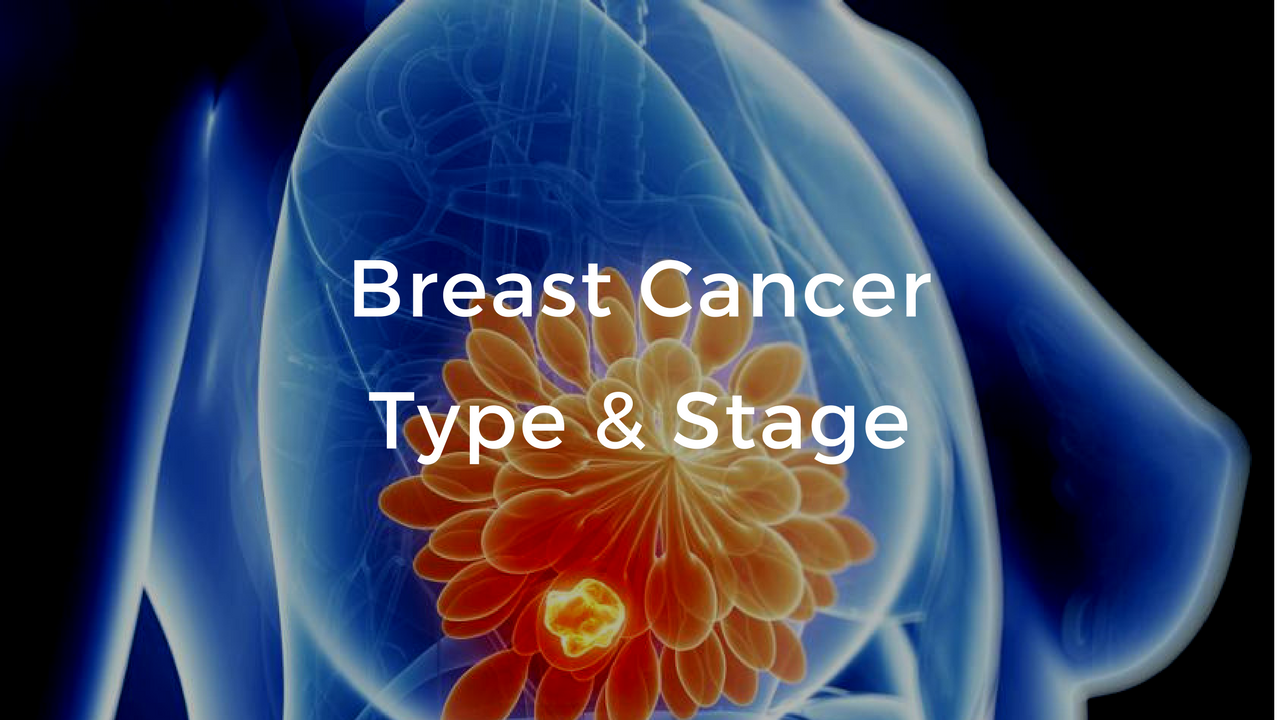
Primary breast cancer is breast cancer that has not spread outside the breast or the lymph nodes (glands in your armpits). There are several different types of primary breast cancer. It can be diagnosed at different stages. Breast cancer is staged from stage 1 to stage 4. Primary breast cancer is different from secondary breast cancer. Secondary breast cancer is when breast cancer has spread to other parts of the body.
Secondary Breast Cancer
Secondary breast cancer is when breast cancer spreads from the breast and lymph nodes (glands in your armpits) to other parts of the body. When cancer spreads to other parts of the body, it can form another tumor. This is called secondary cancer.
Secondary cancer is also called:
- Stage 4 Cancer
- Metastatic Cancer
- Metastasis or Metastases
- Advanced Breast Cancer
Breast cancer can spread to many parts of the body. The most common parts are:
- Bones
- Lungs
- Liver
- Brain
If breast cancer spreads to other parts of the body, it is still called breast cancer. For example, breast cancer that spreads to the bone is called secondary breast cancer in the bone.
Secondary breast cancer can be treated, but not cured. Treatment for secondary breast cancer helps with symptoms and stops the cancer from spreading further. If someone has secondary breast cancer, they will always have it. Breast cancer specialists will talk to the person about the different ways they can manage their symptoms. A person living with secondary breast cancer will be involved in making decisions about their treatment and care. It’s important these decisions are right for the individual.
DCIS
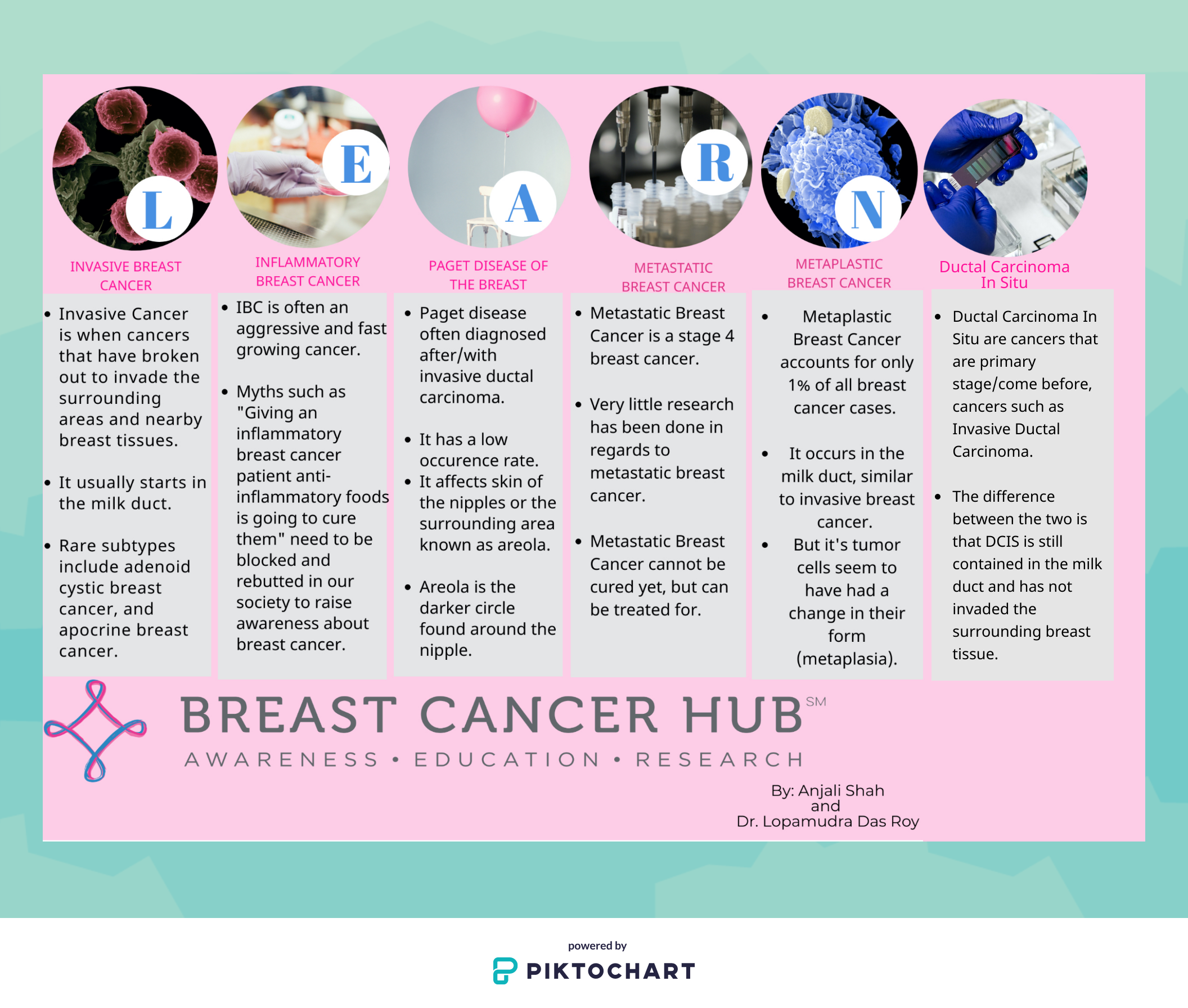
DCIS means Ductal Carcinoma in Situ. It is the earliest form of breast cancer. DCIS is when the cancer cells are still inside the parts of the breast where they first formed. These parts are called lobules or ducts. In DCIS, “in situ means the cancer cells have stayed in the lobules or ducts. DCIS might also be called:
- Non-invasive breast cancer
- Pre-invasive breast cancer
- Pre-cancerous change
- Intra ductal breast cancer
- Ductal intraepithelial neoplasia (DIN)
- Stage 0 breast cancer
Invasive breast cancer
Invasive breast cancer is the most common type of breast cancer. In the past, it was also called invasive ductal carcinoma.
Invasive breast cancer means that the cancer cells have grown through the lining of the ducts into the surrounding breast tissue. Invasive breast cancer starts as DCIS, but not every DCIS will turn into invasive breast cancer. Most cases of DCIS are treated because it can become invasive breast cancer in the future. DCIS is an early form of breast cancer and it can be cured with treatment.
Inflammatory Breast Cancer
This is when cancer cells spread into and block the tiny channels (lymph vessels) in the skin of the breast. The breast then becomes inflamed and swollen. Inflammatory breast cancer is rare.
Paget’s Disease Of The Breast
This is a condition that causes a red, scaly rash (like eczema) on the skin of the nipple. Women with Paget’s disease of the breast may have DCIS or invasive breast cancer.
Treatment
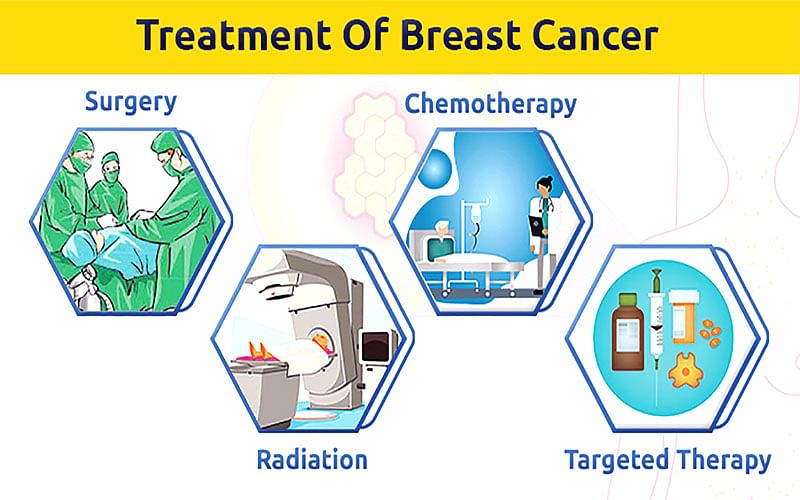
Breast cancer treatment often starts with surgery to remove the cancer. Most people with breast cancer will have other treatments after surgery, such as radiation, chemotherapy, and hormone therapy. Some people may have chemotherapy or hormone therapy before surgery. These medicines can help shrink the cancer and make it easier to remove. Your treatment plan will depend on your particular breast cancer. Your healthcare team considers the stage of the cancer, how quickly it’s growing, and whether the cancer cells are sensitive to hormones. Your care team also considers your overall health and what you prefer. There are many options for breast cancer treatment. It can feel overwhelming to consider all the options and make complex decisions about your care. Consider seeking a second opinion from a breast specialist in a breast center or clinic.
The main treatments for breast cancer include:
- Surgery
- Chemotherapy
- Radiotherapy
- Hormonal Therapy (also called endocrine therapy)
- Targeted Cancer Drugs and Immunotherapy
- Bone Strengthening Drugs (bisphosphonates)
You usually have a combination of these treatments, depending on your situation. This is why your treatment may be different from other people with breast cancer.
Surgery for Breast Cancer
Most people begin their breast cancer treatment with surgery. Some people may have chemotherapy or hormonal therapy before surgery.
There are different types of surgery:
- Lumpectomy: Depending on the size and position of the cancer, you might be able to have just the cancer and a border of normal breast tissue removed. This is also called a lumpectomy or wide local excision.
- Mastectomy: Your surgeon may recommend you have the whole breast removed. This is a mastectomy. You can have a new breast shape made (a breast reconstruction) at the time of surgery, or sometime later.
- Surgery to the Lymph Nodes: Cancer cells can break away from the breast tissue and go to other parts of the body. If this happens, it usually first spreads to the lymph glands (nodes) Open a glossary item in the armpit (axilla) close to the breast.
Radiotherapy
Radiotherapy uses high-energy X-rays to kill cancer cells. You usually have radiotherapy after breast-conserving surgery. This is usually between 5 to 15 radiotherapy treatments (fractions). Some people may also have radiotherapy after a mastectomy. For example, if the cancer has spread to the lymph nodes or is bigger than 5cm. Depending on your situation, you may also have radiotherapy to the lymph nodes in your armpit.
Chemotherapy
Chemotherapy uses anti-cancer (cytotoxic) drugs to destroy cancer cells. The drugs circulate throughout the body in the bloodstream. You might have chemotherapy before surgery, after surgery or both. Chemotherapy before surgery is called neo adjuvant treatment. The aim is to shrink the cancer before the operation and reduce the risk of the cancer coming back in the future. This means that some people may be able to have breast conserving surgery, instead of a mastectomy. Chemotherapy after surgery is called adjuvant treatment. This can help to reduce the risk of the cancer coming back.
:max_bytes(150000):strip_icc()/chemo-or-radiation-5201556-FINAL_NEW-04512dc3baf1488d97aafb0795426f5e.jpg)
Hormone Therapy
Some breast cancers need the hormone oestrogen to grow. Hormone therapy works by lowering the levels of this hormone in the body or blocking its effects. Hormone therapy is only likely to work if the breast cancer cells have proteins (receptors) for oestrogen. They are called oestrogen receptor-positive breast cancer. The most common way to have hormone therapy is after surgery for breast cancer. You usually have it for 5 years or more. But exactly how long you have it depends on the type of drug and the side effects you may have. You may also have hormone therapy before surgery. This is to try to shrink the cancer before the operation. This is called neo-adjuvant hormone therapy.
Targeted Cancer Drugs and Immunotherapy
Targeted cancer drugs work by targeting the differences in cancer cells that help them to grow and survive. Immunotherapy works by helping our immune system recognize and attack cancer cells. There are a number of targeted cancer drugs but not all will be suitable for you. Some targeted drugs are only available if the breast cancer cells have certain receptors. For example, some breast cancers have large amounts of a protein called Human Epidermal Growth Factor 2 (HER2). These are HER2-positive breast cancers. So in this situation, you may have treatment that targets the HER2 receptors.
Bisphosphonates
Bisphosphonates are drugs that help prevent or slow down bone thinning (osteoporosis). They can help to strengthen bones and reduce the risk of bones breaking. You might have bisphosphonates to help prevent or slow down bone thinning. You may also have it to reduce the risk of breast cancer spreading to the bones if you have had menopause. You usually have a drug called zoledronic acid or sodium clodronate.
Support

There are many organizations, support groups, books, videos, and other resources to help you cope with breast cancer and its treatment. There is also information about mastectomy wear and prosthesis suppliers. You may get support from your healthcare team. Your GP, cancer doctor, or specialist nurse is often able to talk to you about what is happening and how you feel. They may be able to arrange more support for someone else for you to talk to. Or you can visit one of these websites for more information and support:
Thank you for visiting my blog and taking the time to read today’s quite lengthy post, before I say goodbye, I just want to say a quick Happy Birthday to my dad who will be celebrating it this Saturday. Anyway, I hope you all have a lovely week and I shall see you next time!


 Peytons View
Lots of good info here, thank you. I’m sorry to hear about all the troubles. Prayers…
LikeLiked by 1 person
Great information and an excellent way to get the word out. Thank you for all you do.
LikeLiked by 1 person
An important message – thank you for sharing, Linda xx
LikeLiked by 2 people